
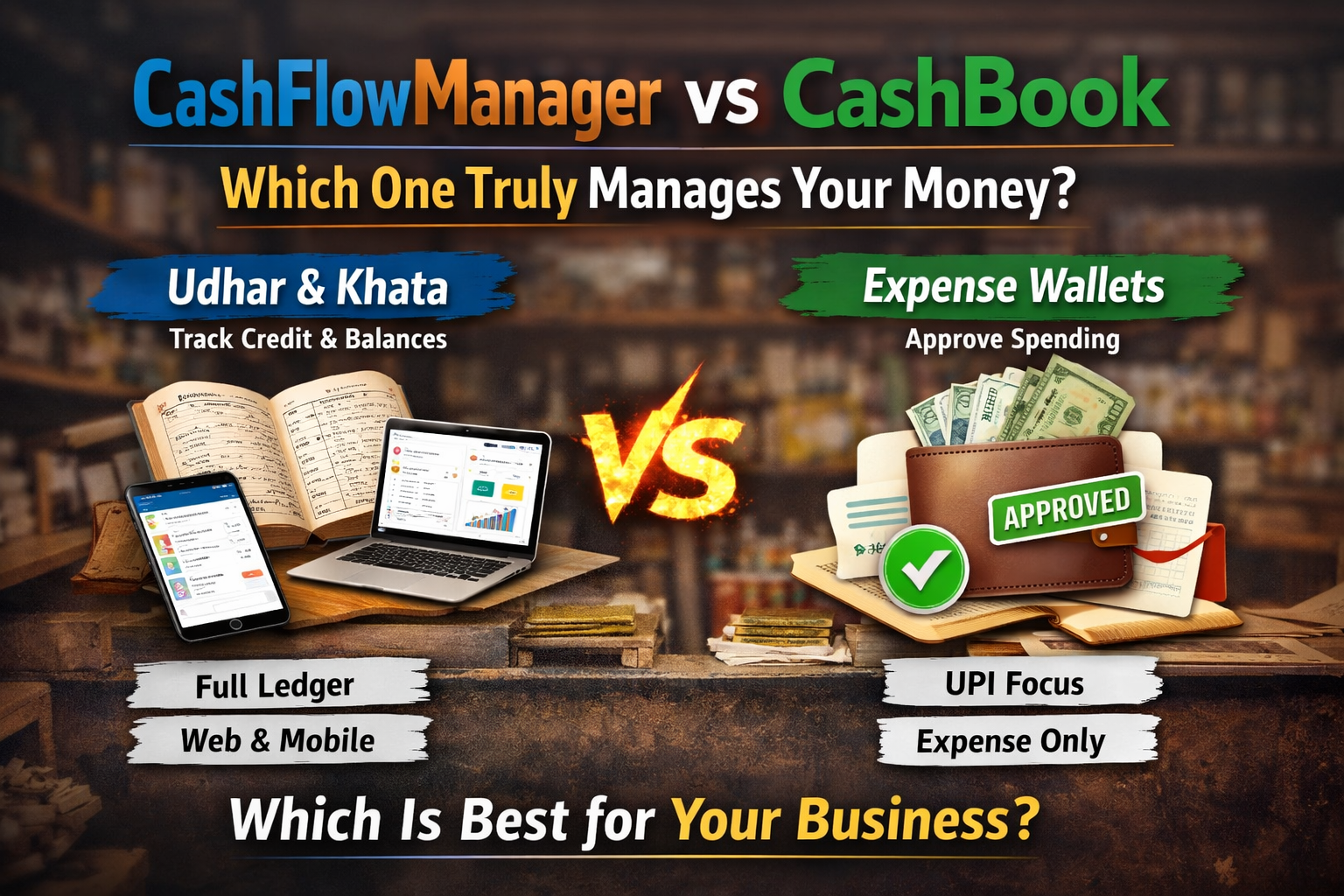
CashFlowManager vs CashBook: Which One Truly Manages Your Money?
CashFlow
Saturday, December 27, 2025
Let’s start with a simple question.
At the end of the day, do you know exactly who owes you money and how much? If your answer isn’t an instant “yes,” then this comparison matters.
Across India, Pakistan, and South Asia, money doesn’t move in neat monthly cycles. It moves daily, through udhar, credit, and handwritten khata entries that live in memory as much as on paper. Any app that ignores this reality will always feel incomplete.
This article looks at CashFlowManager and CashBook from that real, everyday perspective.
The Real Question You Should Be Asking
Most apps ask: “How much did you spend?”
But most people actually need to know:
-
Who hasn’t paid yet?
-
How much credit is still open?
-
What is my real cash position today, not last month?
This is where the difference between these two platforms becomes clear.
How Money Actually Works on the Ground
For shop owners, freelancers, family businesses, and growing teams, money management usually means:
-
Giving goods or services on udhar
-
Receiving payments in parts, not all at once
-
Maintaining a running khata
-
Mixing cash, bank transfers, and online payments
-
Checking balances multiple times a day
If an app can’t answer these questions quickly, it adds work instead of removing it.
What CashFlowManager Is Built to Solve
CashFlowManager is designed around one core idea: understanding cashflow, not just recording transactions.
It allows users to:
-
Maintain clear khata-style ledgers
-
Track udhar and outstanding credit
-
See how every entry affects the running balance
-
Manage multiple books for business, personal, or family use
-
Share access with partners or staff
-
Work offline and sync automatically later
The focus is not on control for its own sake, but on visibility and confidence.
Where CashBook Takes a Different Approach
CashBook is structured primarily around expense control. It works best in environments where spending needs approvals and limits.
That approach can be useful in corporate settings, but it does not fully address:
-
Ongoing credit relationships
-
Long-running khata balances
-
Day-to-day cashflow clarity
For users whose businesses depend on credit and trust, this difference is not small, it is fundamental.
Khata and Udhar: The Practical Difference
Here is a simple test.
If a customer asks,“How much do I still owe you?” Can you answer in seconds?
CashFlowManager is designed for exactly this moment. Credit, partial payments, and balances are treated as core data, not side notes.
CashBook, by contrast, focuses on what was spent, not what is still pending.
For many South Asian users, that alone determines which app feels usable long term.
Pricing, Value, and Long-Term Use
CashFlowManager follows a feature-based pricing model, aimed at giving users a complete system rather than charging for every additional person or wallet.
There is also a 10% discount on all paid plans when billed annually, making it especially attractive for users who want stability and predictable costs.
Instead of paying more as your business grows, you invest once in better visibility.
Web Access and Public Beta
Another important question: Do you only work from your phone?
CashFlowManager is expanding beyond mobile. The web portal is now available in public beta for laptop and desktop users, making it easier to:
-
Review data on a larger screen
-
Work comfortably during office hours
-
Share access with partners or accountants
This reflects how people actually work, switching between mobile and desktop throughout the day.
So, Which One Truly Manages Your Money?
If money management for you means:
-
Knowing your daily balance
-
Keeping a reliable khata
-
Managing udhar and credit without confusion
-
Accessing your data across devices
-
Paying a fair price for real features
Then the answer becomes clear.
CashBook helps manage spending. CashFlowManager helps you understand your money.
Download the CashFlowManager App
CashFlowManager is available on both major platforms, making it easy to start managing cashflow immediately.
Android users can download the CashFlowManager app from Google Play https://play.google.com/store/apps/details?id=com.devsherd.inoutflow
iPhone users can download CashFlowManager from the Apple App Store https://apps.apple.com/pk/app/inout-flow/id6749755237
With offline support, real time syncing, and upcoming web access, CashFlowManager functions as a complete cashflow management system.
Final Thought
A mature financial tool should not force you to change how money works in your life. It should adapt to it.
By focusing on cashflow, credit, and clarity—and by offering flexible pricing, annual savings, and a growing web platform, CashFlowManager positions itself as a long-term solution for the way South Asia actually does business.
Sometimes the best question isn’t what did I spend? It’s where do I really stand today?
Share this article
Tags